Despite cruising through cities at up to 25-45 km/h, cargo bikes are taking a while to catch on. According to Germany’s 2023 Bicycle Monitor, 75% of people had heard of cargo bikes, but only 3% of people had used them. Perhaps it’s because people aren’t sure where or how to use them. Even as cities add cycling paths, some cargo bikes are too large for recreational bike lanes, and other cargo bikes are too small to keep up with road vehicles. In other words, they operate in an infrastructure limbo.
Yet the more important question is why would you use cargo bikes in the first place? And the answer isn’t just in their environmental and congestion benefits. It’s their unique ability to meet various personal and commercial urban needs that sets them apart. Few other transport modes offer such versatility.
“They are a real alternative to a private car or van,” said Eileen Niehaus, Managing Director of cargobike.jetzt, a Berlin-based cargo bike agency that created UMX’s free online course: Cargo Bikes: Revolutionising Urban Delivery. UMX spoke with Eileen to learn more about cargo bikes. We discussed what cities need to know to get more cargo bikes on our streets instead of just spinning their wheels.
Who is already using cargo bikes and for what purpose?
You might think ‘cargo bikes’ are just for deliveries and other ‘cargo’ items. But that’s only a small fraction of how cargo bikes are being used in Germany through pilots with cargobike.jetzt. Eileen shared, “We have collected a lot of cool examples from different companies and municipalities using cargo bikes, like collecting trash and maintaining parks.”
Recent cargo bike use cases from cargobike.jetzt’s pilots
Note that the following links are in German and can be translated into English using browser plug-ins or a translation website.
- Handicrafts: carpentry crew, pipe cleaner, chimney sweep, stonemason
- Food and beverage: restaurant and beer garden supplier, bakery, vegetable co-ops, mobile café
- Essential services: firefighters, blood sample collectors, hospital campus logistics managers
- Culture and personal care: museum exhibit, hairdresser
- Children: school commutes, youth social worker
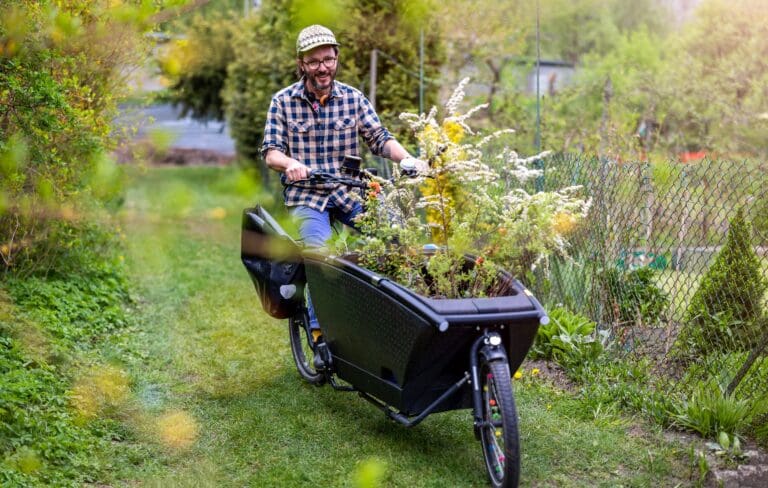
Even the local undertaker can come by cargo bike! Easy access to cemeteries and other green zones is an often overlooked selling point of cargo bikes. Eileen noted, “There are a lot of gardeners who said, ‘This is so cool to have a cargo bike because we can go into the parks and we don’t need a bigger van.’”
Picture your business on a cargo bike. If St. Nicholas can do it, maybe you can too.
“Most of the time, cargo bikes are less expensive than vans,” Eileen continued. “They’re much more flexible and sometimes faster in dense areas with a lot of traffic.” Both companies and city planners should explore ways to promote cargo bikes for daily use. “This is what we are doing day after day at cargobike.jetzt,” said Eileen, “bringing these images, these stories to the street and making it more visible.” You can catch her on the streets of Düsseldorf in the UMX YouTube video: How to get people interested in cargo bikes?
What kind of cargo bike do I need?
In the first module of UMX’s free course on cargo bikes, you will learn about the many different kinds of cargo bikes on the market. Some store cargo in the front; others store cargo in the back. Some have two wheels; others have three or four wheels; and there’s the potential for the cabins and trailers, as well as electric motors. Trailers are particularly important because you can use them with existing bikes without purchasing an entirely new vehicle.
To find the best cargo bike setup for you, Eileen reiterated the importance of use cases. “I have to know the conditions of my cargo: How heavy are my goods? What is their volume? How fragile are they, and how much protection will they need? I also have to see the topography and the infrastructure in my city: Is it hilly or not? Do I need a motor? If so, what kind of battery do I get?” Once you have those details sorted out, you can start shopping for cargo bikes. On the commercial side, cargobike.jetzt can help you find the right cargo bike for your business.
Heavy-duty bikes are currently the topic of ongoing discussions at a European level. These vehicles weigh over 300 kg and use a high-voltage motor, which is why some advocates believe they belong in their own vehicle classification. The debate centres around the term “e-bike,” which can be confusing because it’s commonly used as an umbrella term for two different types of electric bikes. The first type, pedelecs, are electric bikes that max out at 25 km/h and 250 watts, and only assist riders while pedaling. The second type, s-pedelecs, max out at 45 km/h and 4,000 watt; they’re classified as mopeds since riders don’t need to pedal to move forward. If your use case requires a heavy-duty cargo bike, be sure to follow cargobike.jetzt’s latest updates.
Where can I ride a cargo bike?
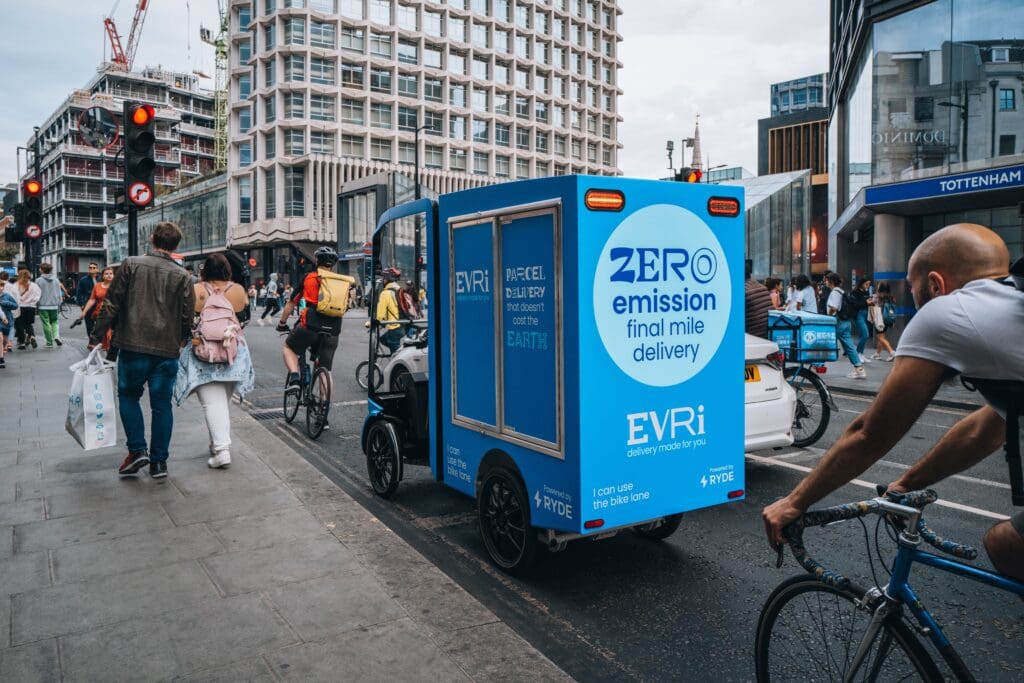
Cargo bikes that run on s-pedelecs (heavy-duty bikes with faster, more powerful motors) must ride in the road with other motor vehicles. All other cargo bikes, electric and manual, must use the bike lanes if one is designated. Sometimes that’s easier said than done. Eileen assured us that in Germany, “If you can’t use the bike lane because it’s destroyed, blocked, too big, or whatever the reason, you are allowed to use the street.”
Many cities, especially older ones, have poor cycling infrastructure, which prevents cargo bike adoption. Eileen pointed out, “This is a big problem for normal bikes, but you feel the poor quality more on a cargo bike because you could be riding with fragile goods or your kids.” Three-wheel cargo bikes present additional challenges: They can be too wide for narrow bike lanes, and potholes and other surface problems throw off your balance. Eileen didn’t want us to forget about cobblestones either. “They’re beautiful, but they’re not useful for bikes. When I was pregnant with my daughter, I could feel it in my belly.”
Lack of continuity is a common yet critical cycling infrastructure issue that many cities face as well. As Eileen put it, “All of a sudden the bike lane ends and you’re like, ‘What do I do?’ You have to navigate on the spot – and it’s not just you.” There are other riders, drivers, and pedestrians all trying to figure out their next moves at the same time. Even measures like bollards and S-curve gates to prevent cars from entering a zone inadvertently block cargo bikes. Upgrading similar vehicle access restrictions should take minimum cargo bike widths into account. “We see this as a problem not only with cargo bikes but special bikes,” added Eileen. “We want more older people using bikes when they have less balance and mobility impairments, but they also need more space.”
Promoting cargo bike use with incentives, like purchase subsidies, isn’t enough. We also need to improve cycling infrastructure to welcome all types of bikes. The lanes must be securely separated from vehicular traffic, ideally with separate traffic lanes for bikes. Elieen heard so many people saying, “I would like to use a cargo bike, but this infrastructure – the lack of good infrastructure – scares me.” For inspiration, she encouraged people to look at German cities like Hamburg, Munich, Freiburg, and Karlsruhe, along with the German Cycling Logistics Association (RLVD).
What else should I know about cargo bikes?
Aside from cycling infrastructure, the bikes themselves can break down, too. “If you are a commercial user,” Eileen explained, “you need your cargo bike every day, so you need fast maintenance and maybe a spare bike just in case,” just like businesses that use vans. Finding cargo bike specialists can be tough, especially in smaller cities. However, Eileen believes the benefits of cargo bikes are worth it.
More people and organisations should make the switch to cargo bikes. Eileen argued, “When you are a company, it’s really important to know how much time it will take to arrive at a client or to a destination. If you drive by bike, you know how long a trip will take, for example, 30 minutes or less. If you drive by car, you don’t know what traffic or parking problems you’ll encounter. This is a big advantage of the bicycle.”
Age is another surprising edge of cargo bikes over vans, since you don’t need a driver’s license to ride manual bikes and pedelecs. Eileen commented, “We see in our consulting projects and test projects that this is a reason why companies are interested in using cargo bikes.” They can hire flexible part-time workers under 18 years old, which can be a win-win for local economies.
Lastly, Eileen didn’t want us to forget that “cargo bikes are a lot of fun!” Whizzing past bumper-to-bumper traffic, with your groceries or kids in tow, indeed sounds like a delight. “Previously, I worked in bicycle promotion, but I love working at cargobike.jetzt because cargo bikes can bring more people out of their cars and vans.” She’s living proof – and perhaps you’re next!
Feeling inspired to learn more about cargo bikes?
Click here for UMX’s free course on cargo bikes.

Adina Rose Levin
Adina Levin was born and raised in Chicago, and clocked in over 10 years in New York City before moving to Barcelona. As a freelance writer and creative strategist, she explores cities, culture, media and tech.

Eileen Niehaus
As a political scientist, Eileen has been working on mobility and logistics since 2015. While with an NGO in Latin America, she developed sustainable transport concepts. She then deepened her expertise by working on federal research projects. To focus even more on her passion for cycling, she now concentrates on cargo bikes as drivers of the mobility transition and has been part of cargobike.jetzt since May 2021.