Home / Course: Making mobility safe: present and future of road safety
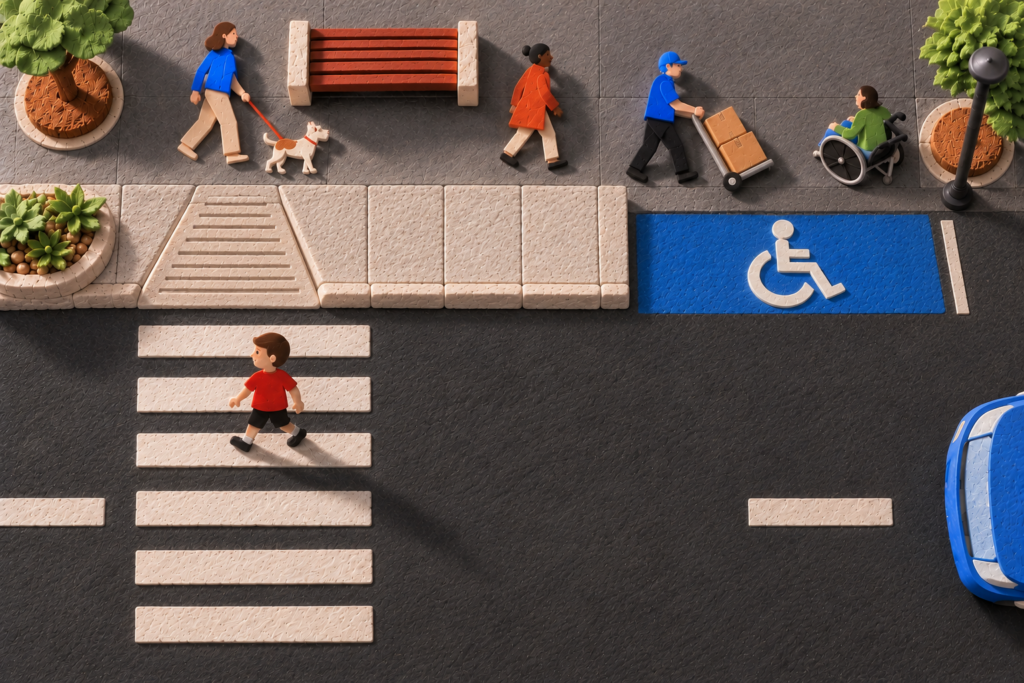
Making Mobility Safe road safety online course – illustration of a child on a pedestrian crossing, people walking and using a wheelchair on the pavement, a kerb ramp and an accessible parking space.

Course: Making mobility safe: present and future of road safety

Current Status

Not Enrolled

Price

Free

Get Started

Present and future of road safety: the Safe System approach, Vision Zero and speed management.

About the Road Safety Course

Behind every road safety statistic is a parent, a child, a neighbour, or a friend whose life was changed forever. Each year, 1.19 million lives are lost on global roads because street design often prioritises vehicle speed over physical human fragility. This road safety course invites you to rethink urban mobility focusing on the people it must serve. Guided by the Safe System approach and Vision Zero, you will discover how forgiving street design, strategic speed management, and compassionate policy can protect physical human fragility. By examining real-world case studies, from Swedish Vision Zero to Dutch Sustainable Safety and Barcelona’s Superblocks, you will gain actionable insights to advocate for equitable, human-centred urban spaces that protect every person on every trip.

Learning Objectives

By the end of the Making Mobility Safe course, you will be able to:

  • Understand the global magnitude of road traffic injuries and identify the physical, environmental, and socio-economic vulnerabilities of pedestrians, cyclists, children, older adults, and micromobility riders in car-centric contexts.
  • Recognise the foundational principles of the Safe System approach, Vision Zero, and Sustainable Safety, shifting accountability from individual driver error to shared systemic responsibility among planners, engineers, and policymakers.
  • Analyse how vehicle speed dictates crash severity, visual narrowing, and stopping distances, applying the 10% survivable fatality threshold to establish safe system speed boundaries.
  • Evaluate how street hierarchisation, self-enforcing infrastructure, proactive data analytics, and advanced vehicle safety features naturally eliminate traffic hazards

Who is this road safety course for?

This road safety course is aimed at professionals from non-engineering backgrounds—including local policymakers, public health workers, fleet managers, and sustainability officers—alongside community advocates, students, and everyday citizens determined to eliminate traffic fatalities and build human-centred streets.

Modules

4 modules

Recommended schedule

2 days

Total length

2 hours

Instructor

Picture of Axel Rimbaud

Axel Rimbaud

Axel Rimbaud is a French engineer and international road safety expert. He created MEL (Movimiento contra el Exceso de velocidad Letal) a Chilean road safety NGO. Through MEL, he worked with a coalition of Chilean road safety NGOs and the Ministry of Transport to reform several laws related to speeding in Chile.

He is an EIT Urban Mobility master program graduate, and now teaches road safety as a guest lecture in the Sustainable Urban Mobility Transitions master program. He was also a finalist of the 2024 EIT Awards in the changemaker category.

He works as a Study Manager for Road Safety and Urban planning for the Cerema, a French public entity and he has been recognized as ‘international road safety expert’ by the French Ministry for Ecological Transition. There he does road safety study for the French state, local governments and municipalities all over Europe recommending solutions to make road safer for all.

Guest Appearance

Warmest thanks to Dr Maria Krafft, Director of Traffic Safety at the Swedish Transport Administration, and Marie-Soleil Cloutier, Professor at INRS and Head of the Pedestrians and Urban Space Laboratory, for their valuable contributions to the course.

Watch the Making Mobility Safe Course Introduction

Making Mobility Safe Course Modules

Module 1: Making mobility safe: Why does it matter?

Discover why road traffic injuries are a global public health crisis and how the Safe System approach and Vision Zero shift responsibility from individual drivers to the people who plan, design and manage our streets.

Key topics:

  • The global burden of road traffic injuries and the human ripple effect on communities
  • Shifting accountability from individual driver error to systemic street design
  • Core foundational principles of the Safe System approach and Vision Zero
  • The Swiss Cheese Model and shared responsibility among planners, engineers, and users

Module 2: Safe and sustainable mobility for all

Explore who is most at risk on our streets, from pedestrians and cyclists to micromobility users, children and older adults, and how to create safe, walkable and connected networks for everyone, regardless of age, gender or income.

Key topics:

  • Prioritising unprotected, vulnerable road users (pedestrians, cyclists, and micromobility)
  • Addressing physical and socio-economic vulnerabilities across age, gender, and income
  • Creating safe, walkable spaces and connected active travel networks

Module 3: The important role of speed design

Learn why speed is the decisive factor in crash severity and how safe speed limits, street hierarchy and self-enforcing design, such as 30 km/h zones and Barcelona’s Superblocks, make streets safer by design.

Key topics:

  • The physics of speed: collision energy, peripheral vision narrowing, and stopping distance
  • Establishing Safe System speed boundaries and the 30 km/h human survivability threshold
  • Street hierarchisation: balancing vehicular movement with local living space
  • Self-enforcing infrastructure and traffic calming solutions, including Barcelona’s Superblocks

Module 4: Innovative Measures and Policy Tools for Zero Fatalities

Review the governance models, data tools, vehicle technologies and policies that help cities and countries move towards zero road deaths, from AI-based hazard detection to post-crash response.

Key topics:

  • Institutional governance and the six operational pillars of road safety management
  • Proactive data analytics and artificial intelligence for early hazard identification
  • Primary (active) versus secondary (passive) vehicle safety technologies
  • Targeting key behavioural risk factors through policy frameworks and post-crash response

Free & Paid options

You can access and participate in the course for free. If you want to earn a  certificate upon completion, you can purchase it. The certificate will be accessible only once the course is successfully completed. Read more here.

Course Content

Log in and enroll to unlock all course materials.
Making mobility safe: why does it matter?
Safe and sustainable mobility for all
The important role of speed design
Innovative measures and policy: tools for Zero Fatalities

Ratings and Reviews

5.0
Avg. Rating
2 Ratings
5
2
4
0
3
0
2
0
1
0
What's your experience? We'd love to know!
Zografia Anna Dimopoulou
Posted 1 hour ago
Fantastic

This course was very helpful to establish the main problems of current road design and vulnerabilities.

×
Preview Image
Ezzi Naidich
Posted 10 hours ago
Engaging way to introduce the Safe System approach to new teammates

I coordinate a team of young people who lead both public policy advocacy projects and youth leadership courses for high school students. Frequently we hire new staff members during high demand months and we need quick and engaging courses to lift them up to a common knowledge with their teammates.

×
Preview Image
Show more reviews
What's your experience? We'd love to know!
Shopping Basket
Scroll to Top