Combining “business” and “sustainability” seems like a no-brainer in urban mobility today. But back in 2016, the need for trained sustainability professionals was clear, especially in the private sector. The trouble was that most MBA programmes focused on business viability over sustainability.
That’s when Massimo Moraglio set about building Technische Universität Berlin’s MBA in Sustainable Mobility Management, which launched in 2017. This three-semester programme accepts 30 students each year. It begins with foundational courses in technology, economics, law, and business. Students then explore emerging trends and mobility behaviour before specialising in electives. Yet what sets this MBA apart are the learning and networking opportunities beyond traditional coursework.
Access to industry insights and leaders
Students are surrounded by industry connections throughout the entire master’s programme, from the expert guest lecturers to the 160 mobility and energy companies located at the MBA’s strategic location on TU Berlin’s EUREF campus. As academic coordinator, Massimo has seen hundreds of students from Asia, the Americas, and across Europe jumpstart their careers upon graduation. “In eight years, none of our students have been denied Germany’s 18-month job-seeking visa,” he stated. “This isn’t to show off, but rather to show the industry’s need.”
To help graduates thrive in the evolving sustainable mobility field, UMX by EIT Urban Mobility began collaborating with Massimo in 2025 to refresh the MBA program. “Revamping means rethinking,” he noted. “We need to connect academic and industry debates about new trends. That’s what to teach, but then there’s also how to teach.” Thanks to UMX, students engage directly with industry leaders, both in class and on field trips, in three redesigned courses that debuted earlier this year and examine those new trends.
Human-centred design in sustainable mobility
By definition, mobility is a fast-moving industry. The shift to sustainability isn’t the only transformation seen in recent decades. User experience has also become key. In urban mobility, that means prioritising people over vehicles and concepts like “mobility for all”. While these ideas are growing more common in several cities, the field of transport has not traditionally focused on consumers, except for private cars, unlike other business sectors like retail and communications.
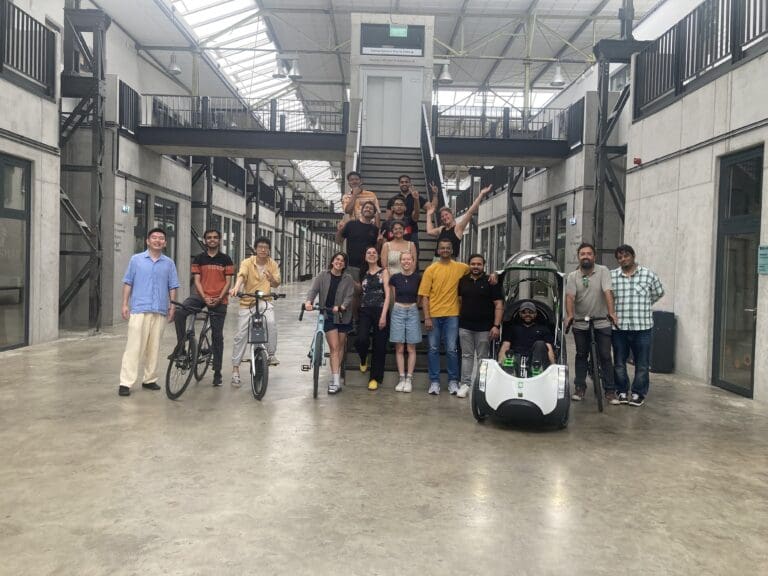
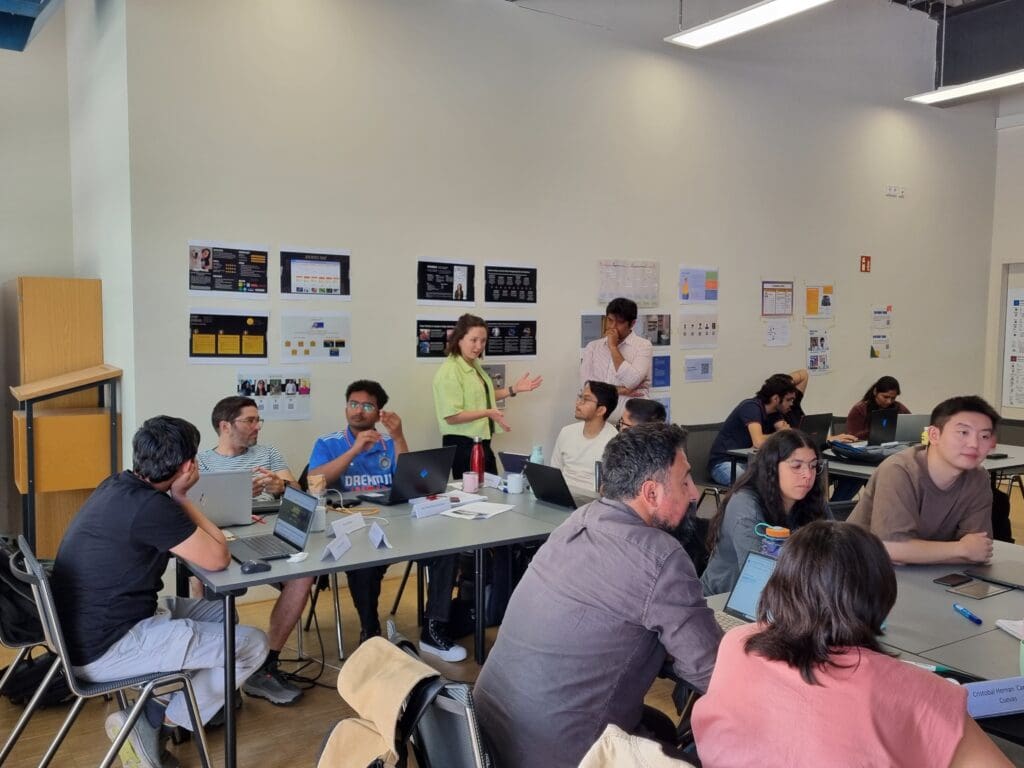
With this in mind, “Mobility Behaviour and Human-Centred Design” was one of the first courses chosen for the revamp. It encouraged students to design for a range of commuting experiences in Berlin, not just the “average user.” Course coordinator Nora Bonatz invited eight guests from various research, industry, and advocacy groups to showcase diverse user perspectives. The group also visited Berlin’s Superblocks, an e-bike and cargo bike provider, and used VR to experience commuting from different viewpoints. Finally, students worked in small groups on case studies of specific commuting personas, sharing their insights through videos and presentations.
“What surprised me most was how much emphasis was placed on social and behavioural aspects of mobility, not just technical or financial ones. Learning about mobility design and user-centric approaches opened my eyes to the fact that sustainable mobility solutions are not only about technology but also about inclusivity and accessibility. It was exciting to brainstorm solutions that combined innovation, inclusivity, and sustainability. I enjoyed seeing how different perspectives came together to create practical ideas that could truly impact urban mobility.”
— Abinayaasri Parthiban, MBA student
Managing innovation and logistics in sustainable mobility
A shift in user mindset is another important trend in urban mobility that the revamped courses sought to address. Due to technological advances and increased accessibility to the world at large, Massimo explained that “physical mobility is not considered to be a winning point anymore.” He added, “It’s not necessarily an adventure anymore, especially for young generations, so it requires new benchmarks.”
In this new paradigm, where everyone is moving around to the point of a so-called “mobility saturation,” Massimo argued that mobility as a service is crucial. Concepts like demand response transport, autonomous vehicles, and shared mobility may still be niche, but they have the potential to become mainstream. Innovation is essential to getting there, making it vital for executives to learn how to manage it.
This thinking inspired the second course that UMX helped revamp: “Innovation and Transformation Management.” It was refashioned into a boot camp, focusing on a case study for Jelbi, a subsidiary of Berlin’s main public transport company, BVG. This large mobility platform integrates public and shared mobility options into an app, with physical outposts at S-Bahn and subway stations. Students worked in small groups on a Jelbi business case to help companies plan budgets for employee travel and commuting. They also engaged with industry guest speakers and Jelbi staff, providing invaluable insight into the real-world business expectations and bridging the gap between academic theory and professional practice.
“I really enjoyed the boot-camp style of learning in the Innovation Management course. It felt fresh and engaging, and it offered a new perspective on how to approach problem-solving and collaboration – and the BVG case as a great case to work on!”
– Aparna Pandey, MBA student
Going places beyond the master’s programme
Much of what students learn in business school stays in the classroom. However, Massimo noted that his MBA students continue raising the bar. “You could see really marketable ideas that were top-notch,” he remarked, “even ready for focus groups.” This success may stem from the cooperative learning format, where students worked closely with companies like Jelbi. “The discussions among peers were interesting, as many company managers were young too,” he added.
Nora, the coordinator of the Human-Centred Design course, agreed in praising the MBA students’ work. “I was truly impressed by their curiosity, creativity, and critical thinking,” she shared. “Their solutions were innovative, their presentations persuasive, and their ability to tackle complex challenges with confidence was remarkable.” As for going beyond the classroom, their projects were showcased in a gallery walk at the EUREF Campus 2025 Sommerfest. Nora also added, “The ideas inspired a research project in which we are designing and testing sustainable commuting solutions for students and employees in Berlin, allowing us to explore and potentially implement some of the concepts developed during the course.”
The MBA students were also impressed with the outcomes. Each of the four learners contacted for the UMX blog mentioned a different expert whose lectures they liked most, highlighting the diverse appeal of the revamped courses. “Additionally, having guest lectures by women who are thriving in the mobility field was truly inspiring,” said MBA student Mariana Aguilar.
The MBA students have important opportunities ahead, as does the programme itself. Massimo hinted at eventually offering the entire programme as an executive MBA, catering to students with limited schedules. “We also need to address continuing education for those who can’t leave their jobs for a three-semester programme but can take one course at a time.” Meanwhile, learners interested in urban mobility can already do this with TU Berlin Academy’s course, Digitizing Mobility, which Massimo and Nora run with support from UMX and EIT Urban Mobility.
Want to dive deeper into this topic?
Interested in applying for the MBA in Sustainable Mobility Management at Technische Universität Berlin? Applications for the 2026-2027 term are due by 31 March 2026. Visit the official website for more details.

Adina Rose Levin
Adina Levin was born and raised in Chicago, and clocked in over 10 years in New York City before moving to Barcelona. As a freelance writer and creative strategist, she explores cities, culture, media and tech.
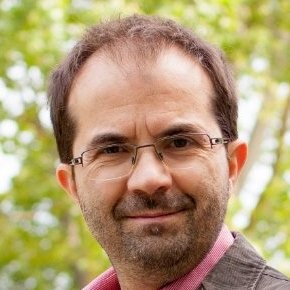
Dr. Massimo Moraglio
Dr. Massimo Moraglio, author of 100+ publications as well as an experienced tech and mobility consultant in the public and private sector. He is also one of the chief architects and instructors of our upcoming partner course with Technische Universität (TU) Berlin’s Academy for Professional Education on Digitalizing Mobility: Practices, Trends, Solution