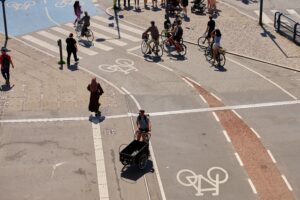

The global gender gap is narrowing in social, political, and economic realms, but it still has a long way to go – perhaps 123 years to reach full parity globally. Gender inequality also extends to the realm of transport, where data shows that women and men don’t have equal access to mobility. Yet we must address this gap carefully to avoid reinforcing gender stereotypes and binaries. Only then can we instead build better mobility solutions for all.
‘In a way, gender mobility is a sensitive topic because people have a lot of opinions and feelings about their own experience,’ said Dr. Christian Dymén from Trivector Mobility in Sweden. He and his colleague, Julia Nyberg, co-authored the free online course on Gender Equal Mobility from UMX.
‘The transport system is a network upon which we live our lives,’ said Julia. ‘We experience it in different ways depending on who we are.’ Factors both within and outside our control shape our identities, values, and households, which are reflected in our transport behaviours. Who is commuting to work? Who is taking the kids to school? Who is taking elderly relatives to the doctor? Who is running the errands? And, of course, who isn’t going anywhere because they’re staying at home? Even though gender is just one part of our identity, it’s often linked to the answers to many of these questions.
Power dynamics at play in our urban infrastructure
When we talk about gender, we’re referring to the ‘socially constructed masculine and feminine identities, governed by social norms and gendered power relations’, as several researchers have noted. The topic of gender within urban mobility has emerged only within the last 40 years, coinciding with the rise of gender studies as a topic in academia and popular culture. ‘When I put those two things together – mobility and gender – I started to see the power relations that are actually built into our urban environment,’ noted Julia.
For decades, women haven’t been at the centre of mobility infrastructure decisions. Women still only make up 22% of the workforce in urban mobility. ‘There has been a male norm in planning for a long time that’s largely rooted in a technical and economically rational practice, with a focus on commuting and moving people efficiently from point A to point B. Other kinds of journeys and experiences are often overlooked, which affects what we actually build,’ said Julia. She specified that car-centric cities are the prime example of this norm in action as traditional gender divisions of labour play out in our streets: Planners prioritised cars and car infrastructure because they assumed that men commuted to work by car while women stayed at home.
As the course on Gender Equal Mobility explains, traditional gender roles are changing, as is the idea that gender is a binary system. That said, research shows that men and women still have different transport preferences. How much of that is because of the infrastructure, and how much is because of gender? Since cities usually build upon existing structures from previous eras, we may never fully be able to separate gender from infrastructure.
Gender isn’t a data point; it’s an entire mindset.
Feminism, as a social movement, is not only about supporting women. It’s about building a society where all genders have equal access to opportunity. The idea of gender equal mobility means everyone, no matter their gender, can move freely around the city. ‘We used to think that if you can move by car, then that means freedom,’ Christian added. ‘But then we dismiss the other means of transport.’ However, gender differences exist in other transport modes, too.
For example, surveys show that women care more about the environment and sustainability. So, why do many of these same surveys indicate that women prefer driving to cycling? It comes down to mindset. ‘Women simply won’t cycle if it’s not safe,’ said Marianne Weinreich in the UMX video, ‘How to make urban cycling more attractive to women?‘ Indeed, women do cycle more in cities with a robust network of protected bike lanes.
Women’s travel behaviours aren’t just a data point to be mindful of. Gender is an entire perspective on mobility that must be factored into planning because the resulting changes in infrastructure often benefit all inhabitants, not just women.
Changing the traditional planning mindset applies to data collection as well. Both course authors urged a fresh look at the classic travel survey because current methods can reinforce the status quo. Julia shared, ‘Surveys capture the trips that you actually do, but not the ones that you want to do but can’t and why not.’ Using the cycling example again, trip chaining is a mostly female mobility behaviour and it’s hard to do by bike unless you have a cargo bike for groceries or kids. But a classic travel survey won’t necessarily tell you that.
The data and analysis missing from planning is usually qualitative and expensive to measure. As a result, many planners still focus on quantitative data, data optimisation, and cost-benefit analysis. This leaves out important insights that could enhance their strategies. Christian argued that these are relics of traditional planning, even as data science emerges in urban mobility. He said, ‘These tools are quite bad at recognizing and understanding the nitty-gritty details of people’s everyday lives,’ so new perspectives are needed.
Mobility of care for all, including men.
Surveys also tend to miss how young people travel and how many women have caregiving responsibilities. Julia shared, ‘In Sweden, most travel surveys are conducted with people who are 16 years old or older, so we don’t know much about how young people travel, nor do we know if adults are travelling with someone, such as a child or relative. That’s huge.’ The course authors suggested re-evaluating the ‘purpose of trip’ category in travel surveys to reflect caregiving, which becomes evident when cities plan with gender top of mind. Or as Christian put it, ‘A gender perspective is also a perspective on care. We have to focus on other aspects of life besides going to work and coming home.’
Men are a vital part of that, too. Prioritising care ‘facilitates both men and women doing the caregiving’, Christian said. Julia agreed and added, ‘Focusing on men just going to and from work is actually a very weird view of men. Many of the men I know are also grocery shopping and picking up kids at kindergarten, sports, or music practice.’ Not all men are stereotypical car-obsessed commuters; they also enjoy walkable and bike-friendly cities as much as the next person. That’s another reason why planners must make sure that transport systems work for everyone, as discussed in the UMX webinar, ‘Addressing the Gender Gap: How to Make Urban Mobility Work for All?‘
‘The transport system cannot solve the gender inequality problem in and of itself’, admitted Julia. ‘But it can help close the gender gap because it helps us live more gender-equal lives.’ Gender equal mobility means equal access to move, live, and thrive in our cities. That affects each of us, no matter our gender, and UMX’s free online course can help put cities on the right track to parity, hopefully in less than 123 years.
Want to dive deeper into this topic?

Adina Rose Levin
Adina Levin was born and raised in Chicago, and clocked in over 10 years in New York City before moving to Barcelona. As a freelance writer and creative strategist, she explores cities, culture, media and tech.

Julia Nyberg (Trivector)
Julia Nyberg is an urban planner specialising in gender equality and socially sustainable mobility. She brings a system-perspective on how transport influences everyday life, safety, and access for different groups. Julia leads both national and international research and consultancy projects that embed gender equality in traffic and mobility planning.

Dr. Christian Dymen (Trivector)
Christian is a consultant, researcher, facilitator, and speaker with a focus on social sustainability, gender- and goal-steered planning processes. He has over twenty years of experience of commissioned work as well as research related to gender equality, equal rights and social sustainability in transport and mobility planning.