
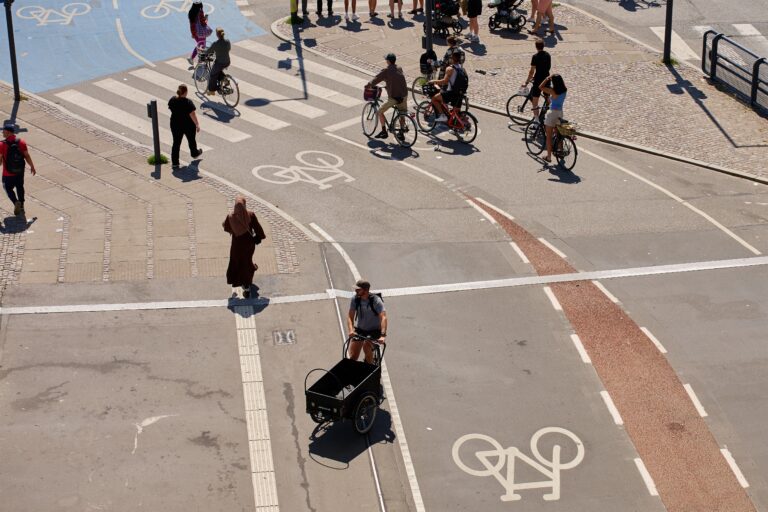
It can take anywhere from an hour to a few days to learn how to ride a bike. In that same amount of time, some ambitious cities can also build a bike lane. Starting in 2020, residents in cities from Berlin to Barcelona woke up to pop-up cycling infrastructure lining their local streets. Quick implementation is great for moving to sustainable mobility. However, new bike lanes have caused confusion for riders, pedestrians, and drivers. We can’t expect entire cities to start moving differently overnight—at least not without a little communication and training.
For a hundred years, street designs have designated rules for cars and pedestrians. Bikes, however, often end up in a grey area.
“It’s very clear where a car can and can’t go,” said Blanca Fondevila, Senior Digital Learning Manager with UMX and EIT Urban Mobility. “With bikes, the rules aren’t so clear. You can guess, but do you really know?” To drive a motor vehicle, you must learn the rules of the road. You also need to pass the driver’s exam. While the bar is significantly lower for bikes, we still need to set benchmarks.
In 1968, the Vienna Convention on Road Traffic codified rules to improve international road safety and traffic, including bike traffic. These rules are still in force, even though they differ from region to region. Some European countries have already introduced or are in the process of introducing additional regulations.
On a surface level, it seems obvious that bikes belong in bike lanes. But what if the lane is too narrow for your bike? Or your bike is faster than most. Even in cities with bike paths, lanes can end at intersections. They also might be blocked due to construction or other issues.
Adding to the confusion are other personal mobility vehicles, such as e-bikes, cargo bikes, and scooters. They are becoming ever more popular, especially among younger people. Simply put, micromobility isn’t a micro market, making these points crucial for understanding sustainable mobility.
To address these questions, UMX made a short game about bike lanes. It’s called ‘Whose Lane Is It Anyway?’ and draws inspiration from top practices in European cities. Tap and swipe to explore cycling infrastructure, watch short videos, and answer quick quiz questions. (No helmet required, though one is always recommended!) You’ll also walk away with important things to keep in mind no matter your vehicle and no matter your city.
It takes less than 10 minutes to complete, so give it a go and let UMX know what you think!

Adina Rose Levin
Adina Levin was born and raised in Chicago, and clocked in over 10 years in New York City before moving to Barcelona. As a freelance writer and creative strategist, she explores cities, culture, media and tech.