How Car-First Planning Shaped Melbourne
“Civilised people commute by car.” That was the underlying ideology of mobility planning in the 20th century, particularly in North America. As car ownership soared, sprawling metropolises were born. Proposals for public transport connecting city centres to nearby suburbs were shelved or, even worse, thrown away. This approach spread fast across the Atlantic and the Pacific. Millions of people still face the consequences of those planning decisions from long ago.
Rowville: A Suburb Without a Train
This story comes to us from Rowville, a suburb of Melbourne, Australia’s second largest city. It’s located less than 30 kilometres east of the inner city. Rowville is home to about 33,000 people, 25,000 cars… and no trains.
For decades, Rowville has been promised a railway to greater Melbourne. Yet years later, the train proposal remains stalled. UMX teamed up with transport planner and YouTuber Philip Mallis to understand what happened and what Rowville’s fate could mean for other suburbs facing similar challenges.
How Melbourne’s Transport Priorities Changed
“Rowville was meant to be a model of modern suburban living, but instead it became a case study in what happens when infrastructure doesn’t keep up with growth,” said Mallis. In less than 25 years, metropolitan Melbourne’s population doubled from 1.2 million people in 1947 to 2.5 million people in 1971. Like many growing cities, most new residents couldn’t fit into the dense city centre, so they looked outside the city to settle down.
As for transport, Melbourne managed to hold on to its railways, at least initially, according to Liam Davies at RMIT University and Ian Woodcock at Swinburne University of Technology. “Car culture wasn’t inevitable… Trams were ripped out of every capital city except Melbourne,” they wrote in The Conversation. Soon, however, the American dream of a big suburban home and driveway (cars included) became an Australian dream as well. Since planners expected more car trips in the future, they made road infrastructure the top priority.
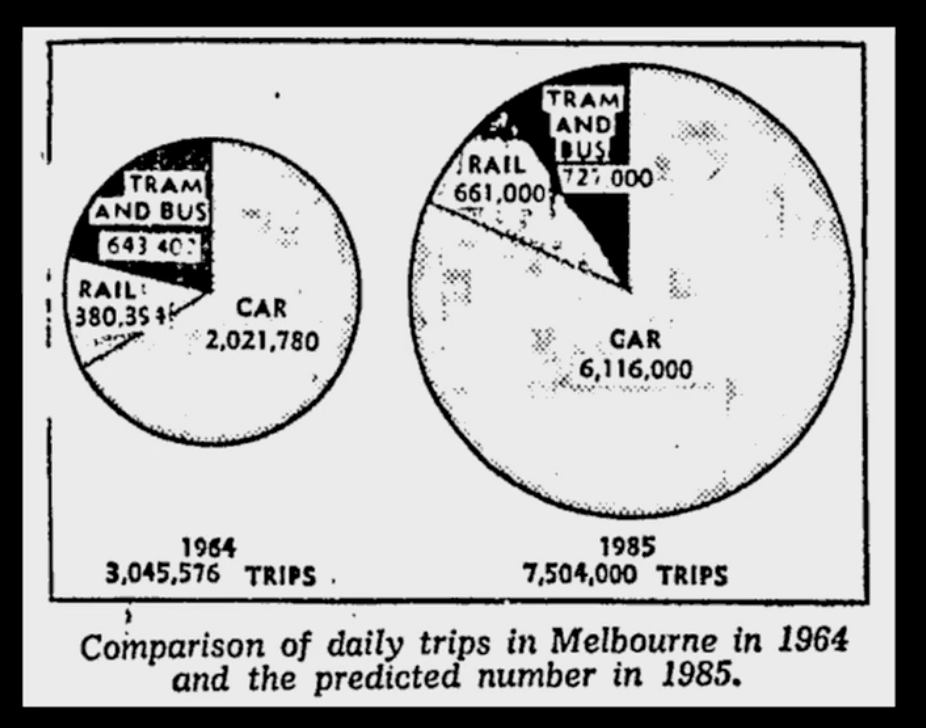
Melbourne Transportation Study (1969) Source: Philip Mallis
Then along came the 1969 Melbourne Transportation Plan. Mallis explained, “A group of American consultants was hired by the government and heralded the start of a massive road-building programme that continues to this day.” Those consultants were Wilbur Smith Associates, now a part of CDM Smith. (The company has since pivoted to building different types of infrastructure, such as water management and energy solutions.) The plan followed the steps of North American cities, such as those in the Western U.S., Canada, and the Sun Belt. Cars were crowned king and public transport was demoted to “lady in waiting.”
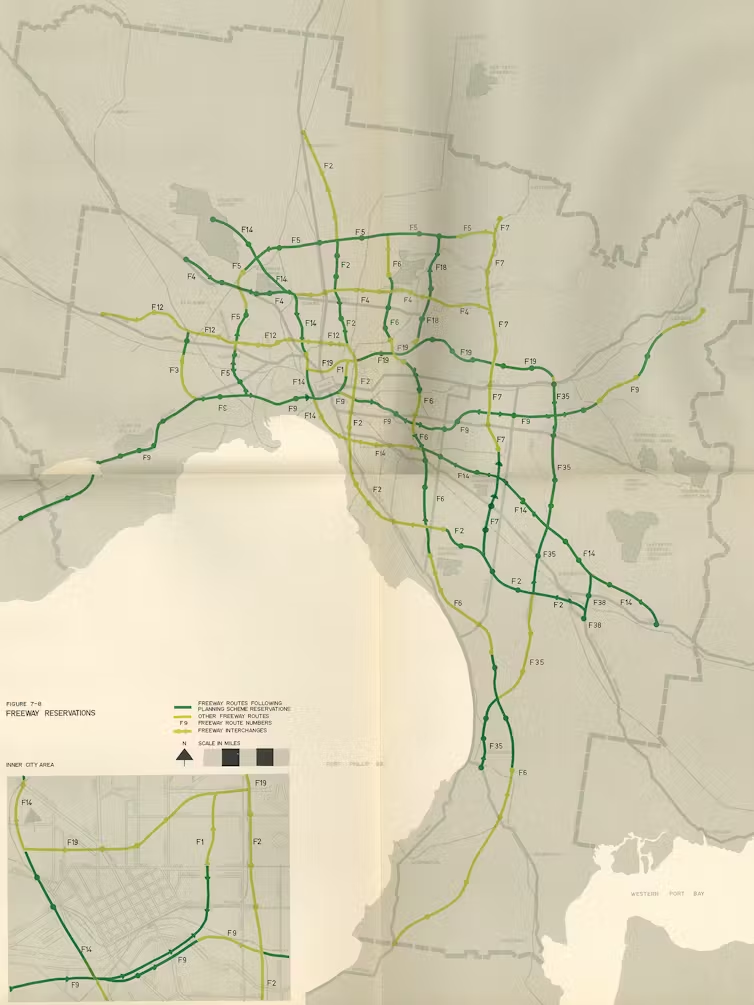
The recommended freeway system. 1969 Melbourne Transportation Plan (Source: The Conversation)
“The wording of the 1969 Metropolitan Transportation Plan is a plan for balancing transport needs in Melbourne. But in reality, it’s a freeway plan,” said Elizabeth Taylor, Senior Lecturer in Urban Planning and Design at Monash University. “The dream of that era of transport planning was that if we build more roads, there won’t be any congestion, which is flatly wrong, but that was the idea.”
The plan aimed to create a free-flowing network of over 1,000 kilometres of roads, split among freeways, highways, and arterial roads. Together, these roads accounted for 85% of the proposed budget. The rest was allocated for railways, both to modernise existing trams and make room for 910 new ones. One of the new proposed railway lines would go through Rowville and connect two existing tram lines. It would have freed up the radial structure of the network, making it easier to travel to both the inner city and the nearby suburbs. But things didn’t quite go according to plan.
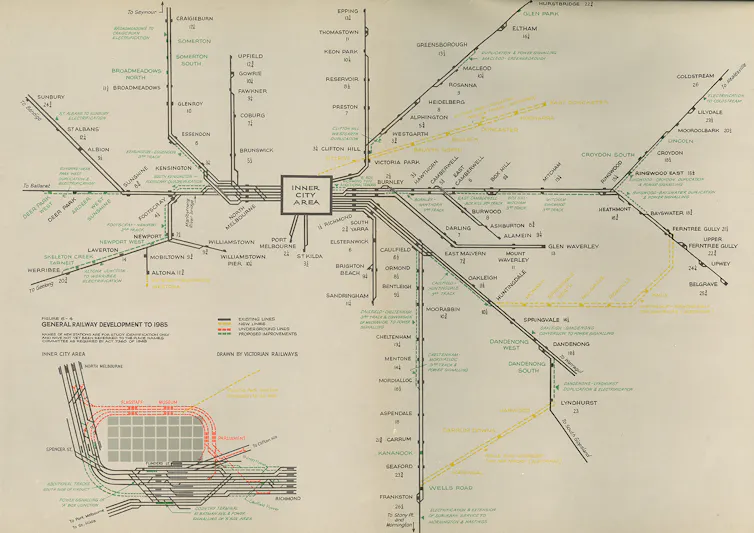
Proposed general railway development to 1985. 1969 Melbourne Transportation Plan (Source: The Conversation)
The city built only half of the planned tram, focusing on the City Loop tunnels instead of the new rail extensions. “The Rowville and Doncaster Rail projects became kind of jokes because they never happened,” chuckled Taylor. The freeways fared slightly better, as more than half were eventually built. That was enough to tip the balance for good toward cars, despite community resistance.
The Consequences of a Car-First City
“This car-first vision,” Mallis explained, “produced a different kind of Melbourne that’s almost entirely residential outside of the dense inner-city core.” Rowville became a classic dormitory suburb, also known as a “commuter town” or “bedroom community,” depending on where you’re from. According to the Australian Bureau of Statistics, 85% of employed residents travel outside Rowville to work.
Census data from 2021 paint an even starker picture of Rowville’s mobility patterns:
- 28.3% of households own three or more registered motor vehicles, 1.5 times the Australian national average (18.8%).
- 2.1% travel to work by public transport, less than half the Australian national average (4.6%).
- 0.5% of people in Rowville travel to work on foot, one fifth of the Australian national average (2.5%).
Life in a Car-Dependent Suburb
To travel to and from Rowville today, you’re stuck between a rock and a hard place: face heavy car traffic or catch one of the suburb’s two main bus lines, Route 901 and 900. Frequency is limited to 15-30 minutes, with no buses on Sunday nights. Perhaps more shockingly, neither route penetrates the area east of Stud Road, where most Rowville residents live.
Mallis said, “The total trip to central Melbourne can still take more than twice as long as driving a car,” and trips to other locations in the metropolitan area can take even longer. One can imagine why many residents feel forced have multiple cars to avoid being cut off from the surrounding region.
“There are all sorts of stories that you hear about young people not having the freedom to move around,” noted John Stone, sustainable transport expert. “But as we get older, we can’t drive, and we become isolated at home. The issue is that we’ve told ourselves that we’re so low-density in these suburbs that we can’t have good public transport. A lot of my work has been to help people understand that’s not the case.”
Community groups in Rowville have strongly advocated for putting trains back on the agenda. This push has grown in recent years, in light of the 50th anniversary of the 1969 Metropolitan Transport Plan. Would the railway be a commuter rail or a light rail line? Or would it happen at all? The issue has become an important flashpoint in local politics, as proposals and funding have come and gone over the years. There’s even an entire Wikipedia page for the Rowville rail line, even though it still doesn’t exist.
Building a Better Public Transport System
To break free of the freeway, Rowville and similar suburbs need to focus on commuters, not cars. They need more than just a railway; they need viable public transport options, plural. Stone continued, “Think about how you put in a connected system so that people can choose where they want to go. The mantra for that is that it needs to be fast, frequent, and connected.”
Want to dive deeper into this topic?
Planning for successful urban mobility systems is the focus of UMX’s online course: Fundamentals of Public Transport: key components for success, authored by transport expert Paul Barter

Adina Rose Levin
Adina Levin was born and raised in Chicago, and clocked in over 10 years in New York City before moving to Barcelona. As a freelance writer and creative strategist, she explores cities, culture, media and tech.